
The SRWA desalination plant treats brackish groundwater through a series of carefully engineered stages. Each step removes contaminants and dissolved salts, producing clean, stable drinking water for the Authority's member entities.
1. Source Water
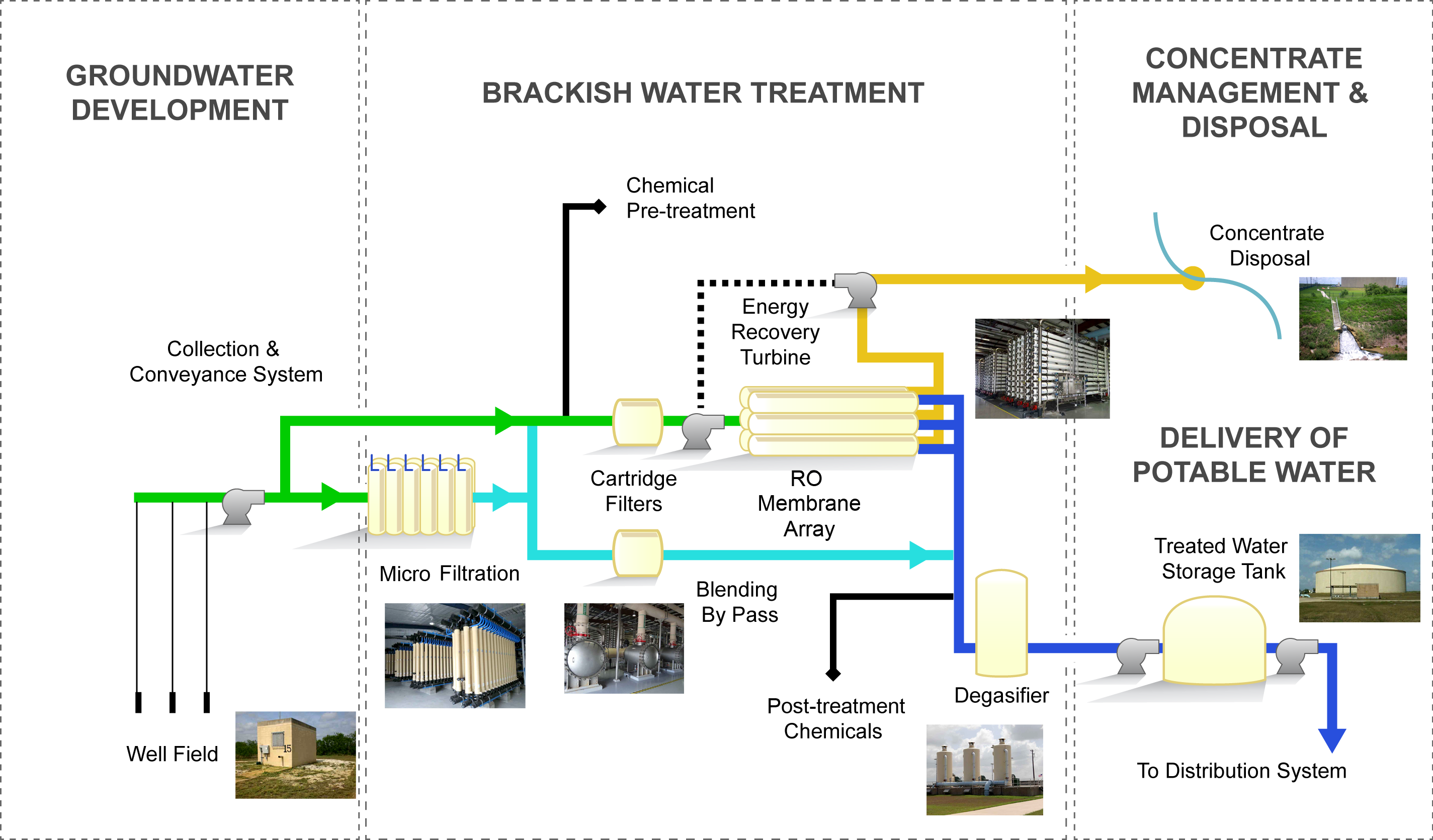
Raw water is drawn from twenty production wells, located approximately 200 to 300 feet below ground level, tapping the Rio Grande Alluvium within the Gulf Coast Aquifer. This brackish groundwater contains roughly 3,500 mg/L of total dissolved solids (TDS) and is pumped 7.2 miles to the SRWA desalination treatment plant.
2. Microfiltration Pretreatment
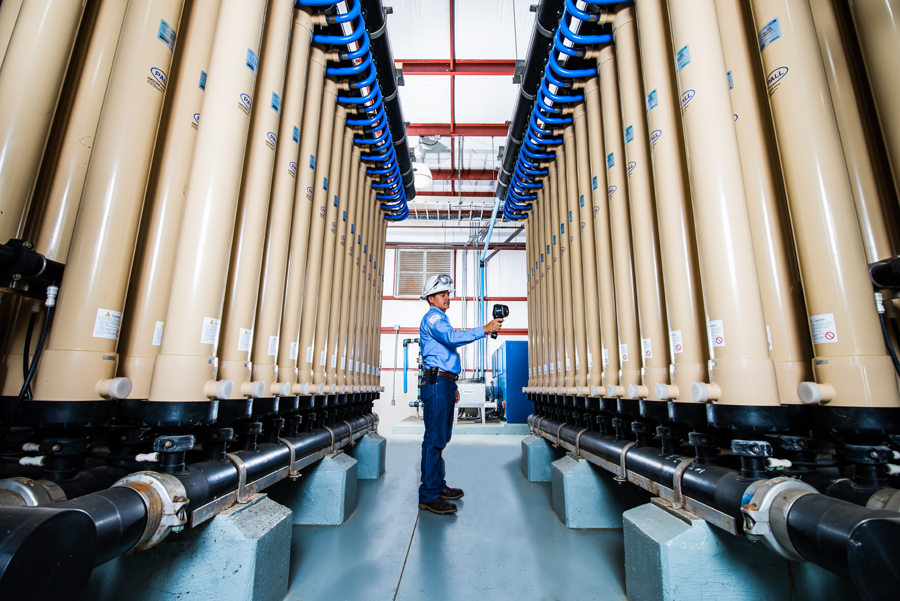
Before the main treatment process, microfiltration pretreatment removes naturally occurring iron, arsenic, and manganese from the source water. This protects the downstream reverse osmosis membranes and improves overall treatment performance.
3. Reverse Osmosis
8
RO trains
75%
Overall recovery
99.6%
Nominal salt rejection
Eight reverse osmosis (RO) trains each provide approximately one million gallons per day, using a two-stage process with an overall recovery of 75%. The vessels are arranged in a 22-11 array, with RO reject water from the first stage feeding into the second stage.
Each vessel contains seven eight-inch brackish water membranes, providing a nominal salt rejection of 99.6%. As of 2015, the plant's daily capacity reached 10.0 million gallons per day.
4. Post-Treatment Stabilization
Because RO-treated water is highly pure, it can be corrosive to distribution infrastructure. To stabilize it, operators blend a portion of the pretreated groundwater with the RO permeate to return minerals to the water.
Additional chemicals — caustic soda and calcium chloride — are added to further stabilize the water prior to distribution, along with chlorine and ammonium sulfate to meet disinfection requirements.
5. Concentrate Disposal
The reverse osmosis process produces concentrated reject water. Up to 4.0 million gallons per day of RO membrane reject water is discharged to an adjacent drainage ditch under a permit issued by the Texas Commission on Environmental Quality (TCEQ).
See the process in person
Schedule a guided tour to see each of these stages in operation.